- +91 9261 2110 03
- ptaimp@gmail.com
- Mon - Sat: 8:00 - 20:00

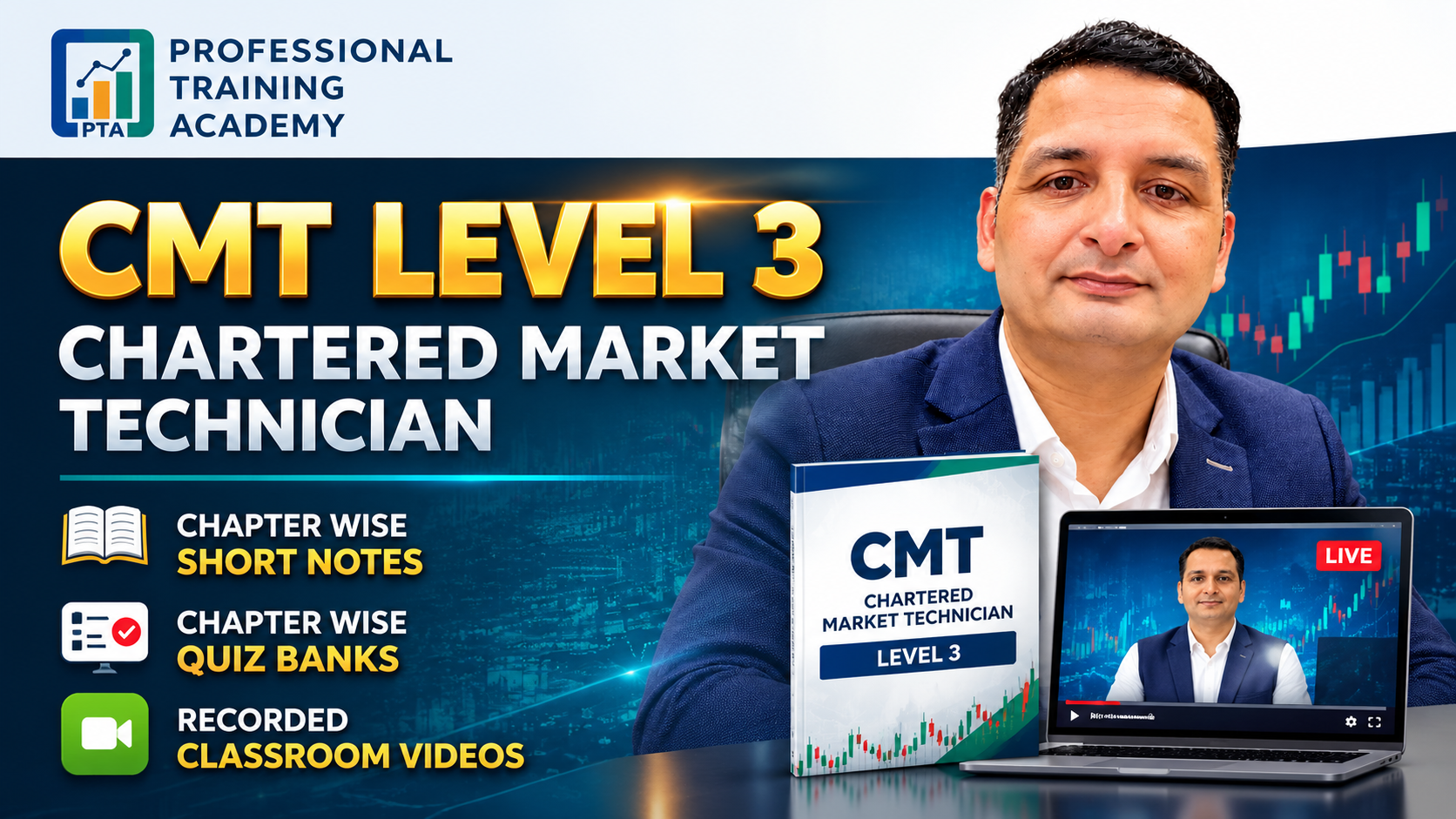
Chartered Market Technician - CMT Level 3 - Live Sessions, Chapter-wise Questions Test Bank, Mock tests, Official Book based Short Notes
Last updated: October 26, 2026
Category:
40,000.00₹
45,000.00₹
12% OFF
Course Duration:
365 day
Course Level:
All Level
Students Enrolled:
39
Tax:
0%
40,000.00₹
45,000.00₹
12% OFF
Course Duration:
365 day
Course Level:
All Level
Students Enrolled:
39
Tax:
0%
What you will learn in this course
The CMT Level III course focuses on portfolio and risk management, trading system evaluation, investment decision-making, behavioral finance, performance measurement, and professional ethics.
Description
Learning Objective –
Section One: Quantifying and Managing Risk
Lesson 1: Perspectives on Risk
Section Two: Classical Chart Analysis
Lesson 1: Classical Chart Patterns
Lesson 2: Candlesticks within a Broader Technical Analysis Framework
Lesson 3: Case Studies in Point-and-Figure Analysis
Section Three: Trend Analysis
Lesson 1: Market Internals
Section Four: Technical Indicators
Lesson 1: Anchored Volume Weighted Average Price Part 1
Lesson 2: Anchored Volume Weighted Average Price Part 2
Lesson 3: Bollinger Bands Advanced Implementation
Section Five: Volatility Analysis
Lesson 1: Volatility Indexes Advanced Concepts
Section Six: Comparative Market Analysis
Lesson 1: Relative Rotation Graphs (RRG) – Advanced Concepts
Section Seven: Systems and Quantitative Methods
Lesson 1: Statistics of Backtesting
Lesson 2: Systematic Approaches, Development, and Risk
Lesson 3: Systematic Counter-Trend Trading and Position Sizing
Lesson 4: Systematic Tactical Asset Allocation
Lesson 5: Trading Systems
Lesson 6: Advanced Quantitative Concepts
Section Eight: Topics in Portfolio Management
Lesson 1: Bridging the Fundamental Gap Fusion Analysis
Lesson 2: Portfolio Construction Employing Relative Strength and Sector Rotation Strategies
Lesson 3: A Practitioner’s Perspective on Portfolio Management
Lesson 4: Digital Assets – Applying Technical Analysis
Lesson 5: Fusion Analysis: Technicians and Fundamentalists Working Together
Lesson 6: Contrarianism, Crowd Behavior, and Overcoming Group Biases
Curriculum
Section One: Quantifying and Managing Risk
Lesson 1 : Perspectives on Risk
CMTL3 - Section 1 - Chapter 1 - Perspectives on Risk MCQs
CMTL3 - Section 1 - Chapter 1 - Perspectives on Risk Case Study MCQs
Section Two: Classical Chart Analysis
Lesson 1 : Classical Chart Patterns
CMTL3 - Section 2 - Chapter 1 - Classical Chart Patterns MCQs
CMTL3 - Section 2 - Chapter 1 - Classical Chart Patterns Case Study MCQs
Lesson 2 : Candlesticks within a Broader Technical Analysis Framework
CMTL3 - Section 2 - Chapter 2 - Candlesticks within a Broader Technical Analysis Framework MCQs
CMTL3 - Section 2 - Chapter 2 - Candlesticks within a Broader Technical Analysis Framework Case Study MCQs
Lesson 3 : Case Studies in Point-and-Figure Analysis
CMTL3 - Section 2 - Chapter 3 - Case Studies in Point-and-Figure Analysis MCQs
CMTL3 - Section 2 - Chapter 3 - Case Studies in Point-and-Figure Analysis Case Study MCQs
Section Three: Trend Analysis
Lesson 1 : Market Internals
CMTL3 - Section 3 - Chapter 1 - Market Internals MCQs
CMTL3 - Section 3 - Chapter 1 - Market Internals Case Study MCQs
Section Four: Technical Indicators
Lesson 1 : Anchored Volume Weighted Average Price Part 1
CMTL3 - Section 4 - Chapter 1 - Anchored Volume Weighted Average Price Part 1 MCQs
CMTL3 - Section 4 - Chapter 1 - Anchored Volume Weighted Average Price Part 1 Case Study MCQs
Lesson 2 : Anchored Volume Weighted Average Price Part 2
CMTL3 - Section 4 - Chapter 2 - Anchored Volume Weighted Average Price Part 2 MCQs
CMTL3 - Section 4 - Chapter 2 - Anchored Volume Weighted Average Price Part 2 Case Study MCQs
Lesson 3 : Bollinger Bands Advanced Implementation
CMTL3 - Section 4 - Chapter 3 - Bollinger Bands Advanced Implementation MCQs
CMTL3 - Section 4 - Chapter 3 - Bollinger Bands Advanced Implementation Case Study MCQs
Section Five: Volatility Analysis
Lesson 1 : Volatility Indexes Advanced Concepts
CMTL3 - Section 5 - Chapter 1 - Volatility Indexes Advanced Concepts MCQs
CMTL3 - Section 5 - Chapter 1 - Volatility Indexes Advanced Concepts Case Study MCQs
Section Six: Comparative Market Analysis
Lesson 1 : Relative Rotation Graphs (RRG) - Advanced Concepts
CMTL3 - Section 6 - Chapter 1 - Relative Rotation Graphs (RRG) - Advanced Concepts MCQs
Section Seven: Systems and Quantitative Methods
Lesson 1 : Statistics of Backtesting
CMTL3 - Section 7 - Chapter 1 - Statistics of Backtesting MCQs
Lesson 2 : Systematic Approaches, Development, and Risk
CMTL3 - Section 7 - Chapter 2 - Systematic Approaches, Development, and Risk MCQs
Lesson 3 : Systematic Counter-Trend Trading and Position Sizing
CMTL3 - Section 7 - Chapter 3 - Systematic Counter-Trend Trading and Position Sizing MCQs
Lesson 4 : Systematic Tactical Asset Allocation
CMTL3 - Section 7 - Chapter 4 - Systematic Tactical Asset Allocation MCQs
Lesson 5 : Trading Systems
CMTL3 - Section 7 - Chapter 5 - Trading Systems MCQs
Lesson 6 : Advanced Quantitative Concepts
CMTL3 - Section 7 - Chapter 6 - Advanced Quantitative Concepts MCQs
CMTL3 - Section 7 - Chapter 6 - Advanced Quantitative Concepts Case Study MCQs
Section Eight: Topics in Portfolio Management
Lesson 1 : Bridging the Fundamental Gap Fusion Analysis
CMTL3 - Section 8 - Chapter 1 - Bridging the Fundamental Gap Fusion Analysis MCQs
CMTL3 - Section 8 - Chapter 1 - Bridging the Fundamental Gap Fusion Analysis Case Study MCQs
Lesson 2 : Portfolio Construction Employing Relative Strength and Sector Rotation Strategies
CMTL3 - Section 8 - Chapter 2 - Portfolio Construction Employing Relative Strength and Sector Rotation Strategies MCQs
CMTL3 - Section 8 - Chapter 2 - Portfolio Construction Employing Relative Strength and Sector Rotation Strategies Case Study MCQs
Lesson 3 : A Practitioner's Perspective on Portfolio Management
CMTL3 - Section 8 - Chapter 3 - A Practitioner's Perspective on Portfolio Management MCQs
CMTL3 - Section 8 - Chapter 3 - A Practitioner's Perspective on Portfolio Management Case Study MCQs
Lesson 4 : Digital Assets - Applying Technical Analysis
CMTL3 - Section 8 - Chapter 4 - Digital Assets - Applying Technical Analysis Case Study MCQs
CMTL3 - Section 8 - Chapter 4 - Digital Assets - Applying Technical Analysis MCQs
Lesson 5 : Fusion Analysis: Technicians and Fundamentalists Working Together
CMTL3 - Section 8 - Chapter 5 - Fusion Analysis: Technicians and Fundamentalists Working Together MCQs
CMTL3 - Section 8 - Chapter 5 - Fusion Analysis: Technicians and Fundamentalists Working Together Case Study MCQs
Lesson 6 : Contrarianism, Crowd Behavior, and Overcoming Group Biases
CMTL3 - Section 8 - Chapter 6 - Contrarianism, Crowd Behavior, and Overcoming Group Biases MCQs
CMTL3 - Section 8 - Chapter 6 - Contrarianism, Crowd Behavior, and Overcoming Group Biases Case Study MCQs
CMT Level 3 Official Book PDF
CMT Level 3 Book PDF
Course Instructor

Course Reviews
5
0 Rating
4
0 Rating
3
0 Rating
2
0 Rating
1
0 Rating