
Become an Industry-Ready Investment Research Analyst

Become a Certified Investment Research Analyst

Accredited Investment Research Analyst (AIRA)

Get Free Course Details Now

What is the Accredited Investment Research Analyst?

Accredited Investment Research Analyst (AIRA) is a comprehensive, industry-oriented certification program designed to develop professionals with the practical skills required to analyze financial markets, evaluate companies, prepare investment research reports, and make data-driven investment decisions.

Unlike traditional finance courses that focus primarily on theory, the AIRA Program emphasizes hands-on learning, real market application, portfolio management, financial modeling, valuation techniques, and professional research report writing. The program is designed to bridge the gap between academic knowledge and the skills expected by employers in the financial services industry.

The curriculum combines 4 months of instructor-led training with 2 months of live portfolio management mentorship, allowing participants to apply their knowledge in real market conditions under the guidance of experienced market professionals.

Why Choose Accredited Investment Research Analyst?

you won’t just understand financial markets—you’ll be able to research, analyze, value, and recommend investments like a professional Investment Research Analyst, making you industry-ready for opportunities across the financial services ecosystem.

Industry-Oriented Curriculum

15+ Comprehensive Learning Modules

4 Months Live Interactive Training

2 Months Live Portfolio Management Mentorship

Real Case Studies & Research Projects

Financial Modeling & Valuation Training

AI Tools for Investment Research

Professional Research Report Writing

100% Placement Assistance

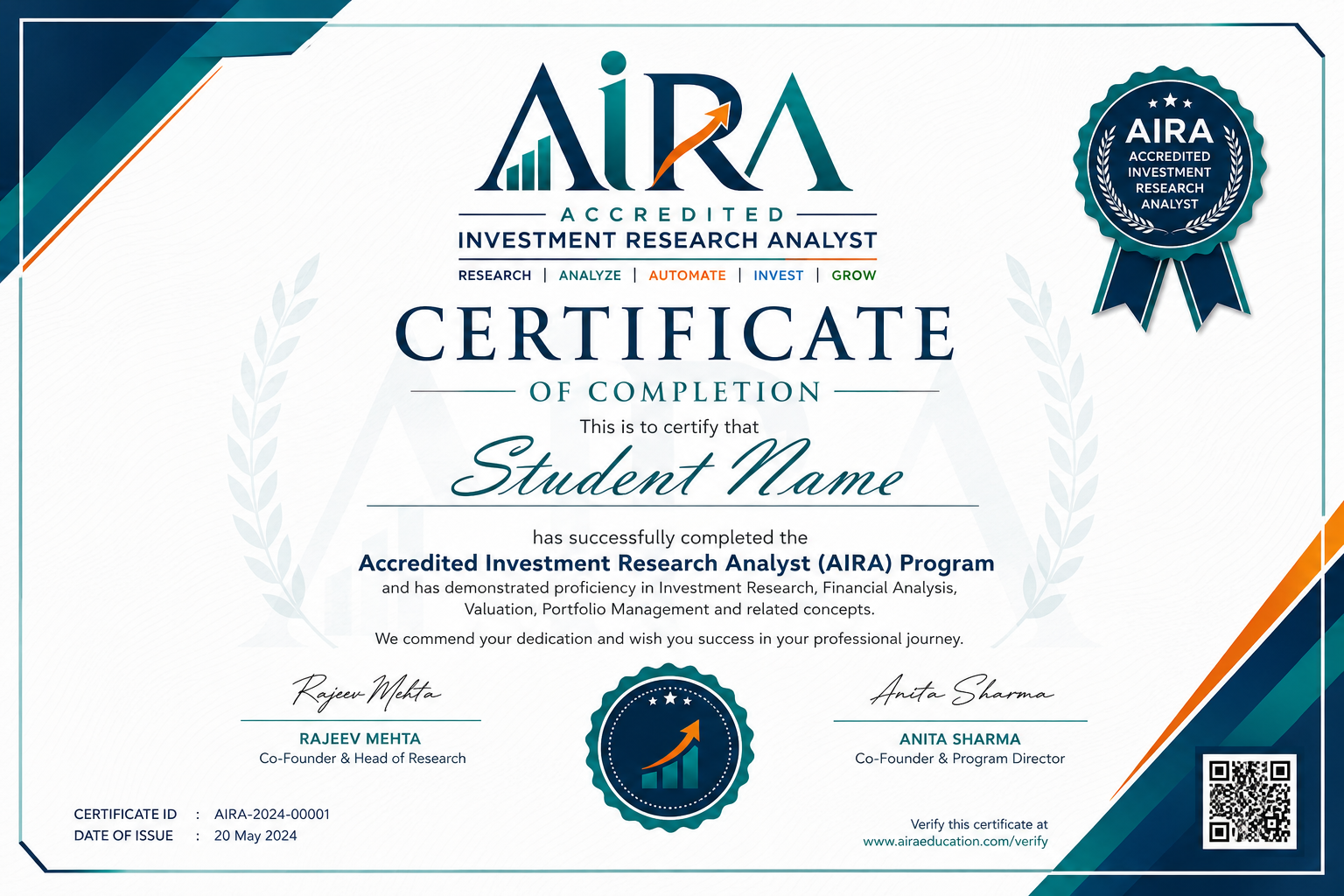
Certification on Successful Completion

What You Will Learn

The AIRA curriculum goes far beyond textbooks. You’ll learn how professional research analysts evaluate companies, identify investment opportunities, build portfolios, and present investment recommendations using real-world data and market scenarios.

Module 1: Introduction to Financial Markets

Overview of Investment, How an Investment Works, Types of Investments, Why Should You Invest?, When Should You Invest, Overview of Risk & Return, Overview of Financial market Products, Overview Financial Markets & Institutions, Type financial institutions & Intermediaries

Alternative Investment Features, Methods, and Structures, Performance and Returns, Introduction to Digital Assets, Investments in Private Capital: Equity and Debt, Natural Resources, Real Estate and Infrastructure, Hedge Fund Strategies, Introduction to Commodities and Commodity Derivatives

Overview on Trading In International Markets, International Investing, Trading Hours, Regulators & Financial Market Intermediaries, Live Case Study & Brokers & Software Access

This includes how to use Support and Resistance, Trend lines, Channels, Fibonacci numbers,Swings, Candlestick and Chart patterns, Harmonic patterns, Market structure, Technical tools -Trending tools, momentum tools, volume tools, volatility.

This course delves into the concept behind various indicators and oscillators, their calculation methods, interpretations
techniques, and practical application in the financial markets.

Module 6: Trading Strategies, AlGO Trading

Automated trading can be helpful in every major financial market, from the NYSE to the Forex (Foreign Exchange). Algorithmic trading courses can show you how to create trading bots for exchanging stocks, Bitcoin, and many other financial assets

Depth knowledge of various derivative instruments, their characteristics, pricing models, trading strategies, and risk management techniques. Options, futures, and swaps to hedge risks, speculate on price movements, and enhance portfolio returns.

Overview of Behavioral Finance, Implications of Dimensions of Behavioral Finance,Rational Managers Vs Irrational Investors, Efficient market hypothesis, Alternate market hypothesis, Knowing Market Anomalies, Overview of Heuristics & Behavioral Biases

Overview of Fixed Income Securities, Overview of Interest Rates & Bonds, Overview of Time Value of Money, Overview of Term Structure, Overview of Term Structure, Types of fixed income securities, Treasury securities, Municipal bonds, Corporate and International bonds, and Structured securities

Overview of Working Capital Management, Overview of Capital Budgeting, Overview of Cost of Capital, Overview of Measures of Leverage, Corporate Governance & ESG – Overview, Corporate Governance: Risks and Benefits, Principles of Corporate Governance Analysis

Module 11: Financial Statement Analysis

Introduction on Financial statement analysis and its framework, Understanding Income Statement, Understanding Cash Flow Statement, Techniques to conduct Financial Statement Analysis, Models to forecast the earnings.

Introduction to Valuation, Enterprise Value (EV), Approaches to Valuations, Asset Approach of Valuation, Introduction to Discounted Cash Flow (DCF) Method, Introduction to Multiples Method of Valuation, Creating Multiple Table, EV / Sales Multiple Valuation, EV / EBITDA Multiple Valuation, EV / MW Multiple Valuation

Overview of Financial Modelling, Overview of Economic & Sectoral Analysis, Overview of Financial Modelling of Financial Statement Analysis, Overview of Building Financial Projections, Introduction to Valuation, Overview of Financial Modelling Report & Presentation

Introduction to Economic Analysis, Demand and Supply Analysis, , The Firm and Market Structures, Aggregate Output, Prices and Economic Growth, Understanding Business Cycles, Monetary and Fiscal Policy, Introduction to Geopolitics, International Trade and Capital Flows, Currency Exchange Rates

Portfolio Management Module would cover the fundamental concepts of risk and return and their application in the context of overall portfolio of a client which would help the wealth manager in making efficient asset allocation with respect to client’s risk and return objectives.

Career Opportunity

Whether you’re a fresher, graduate, or working professional, AIRA prepares you for multiple high-demand roles in the financial sector.

Investment Research Analyst

Equity Research Analyst

Financial Analyst

Wealth Manager

Portfolio Analyst

Investment Advisor

Relationship Manager

Mutual Fund & ETF Advisor

Capital Market Executive

Research Associate

Corporate Finance Executive

Credit & Risk Analyst

Business & Financial Consultant

Financial Market Educator & Trainer

Financial Content Creator

Earn Your AIRA Certification

Receive an industry-recognized certification after successfully completing the program.

Who Can Build a Career with AIRA?

No Prior Experience Required to start your career with AIRA. Whether you’re just starting your career, looking to upskill, or planning a transition into the financial services industry, the Accredited Investment Research Analyst (AIRA) program equips you with practical, industry-relevant skills to succeed in investment research, equity analysis, and wealth management.

Students & Fresh Graduates

Finance & Commerce Aspirants

Working Professionals

Banking & Financial Services Professionals

Traders & Investors

Entrepreneurs & Business Owners

Financial Content Creators & Educators

Career Switchers from any Field

Meet Our Expert Team

At AIRA (Accredited Investment Research Analyst), you’ll be mentored by experienced professionals who have worked across equity research, capital markets, wealth management, portfolio management, and financial education.

Information

CMT Level 1 Study Material

As a matter of fact you can watch live market trading that helps you to connect with CMT. Join a Technical Analysis Course which works on real time markets by using tools & techniques . That’ll give you behavioural understanding of real time Share market. Understanding the money management by real time trading or investment activity. As we know CMT is an MCQ Exam & ask question on application level. Create short notes of Course Content. Get PPT based Short Notes & note interpretation of tools & Techniques on technical analysis. Short Notes help you out to quick revision at the CMT exam time. CMT Books have very complicated language & course content is not properly aligned as it takes topics from various books of different writers. 

So we have to take individual topics and understand concepts in simple, Concise and Clear manner. Take content from various books or websites like Investopedia or Stock Charts on Each Topic for in-depth understanding. Apply tools & techniques with the help of Technical analysis or trading software’s. Read Books twice as MCQ can be created from a single line. while study mark important topics.