
#1 Best Training Institute
Best Financial Planning Course in India
Build the skills and knowledge to manage and grow financial portfolios
- Financial planning and wealth management fundamentals
- Investment, retirement, tax, insurance & risk planning
- Career opportunities & earning potential in financial planning
- How to choose the right course for your career goals
Connect with Us
About financial planning course in India
Financial planning courses in India help learners understand how financial goals can be assessed and managed through investment planning, retirement planning, risk management, financial products and other areas of personal finance. Depending on the programme, learners may also develop knowledge of financial markets, investment analysis, portfolio strategies and client-oriented financial decision-making.
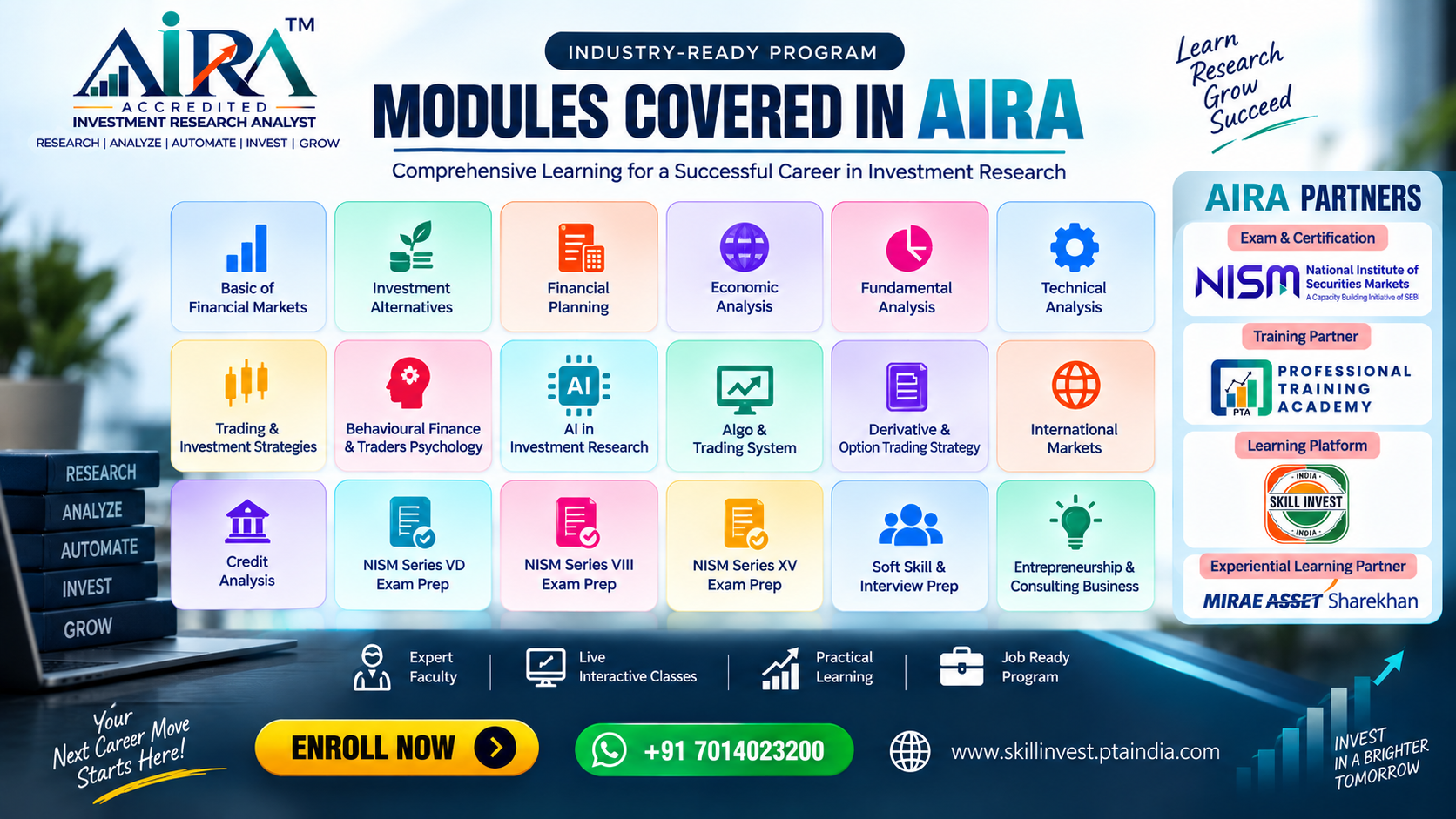
Courses are available in different formats, including short-term programmes, professional certifications and industry-oriented training programmes. For learners looking for a broader finance programme with an emphasis on investment research and market analysis, the Accredited Investment Research Analyst (AIRA) programme offers an industry-oriented learning pathway covering financial planning along with fundamental and technical analysis, economic analysis, investment alternatives, trading and investment strategies, behavioural finance, AI in investment research, derivatives, international markets and credit analysis.
What You'll learn in a financial planning course
Students & Recent Graduates
Finance & Commerce Professionals
Banking & Insurance Professionals
Working Professionals
Wealth Management Professionals
Career Switchers
A Complete financial planning course with AIRA
An industry-ready programme designed to build practical skills in investment research, financial markets and investment analysis.
- 15 advanced modules covering financial markets, investment research and analysis
- Financial Planning, Fundamental & Technical Analysis, Trading and Investment Strategies
- AI in Investment Research, Behavioural Finance, Derivatives & International Markets
- NISM exam preparation for Series V-D, VIII and XV
- Live classes, practical learning, mentorship and career-oriented training
6-Month Programme | 4 Months Training + 2 Months Mentorship


Career Opportunities after financial planning Program
A financial planning course can prepare candidates for roles across financial advisory, investment planning, wealth management and client relationship management. Career options depend on the candidate’s qualification, skills, experience and applicable regulatory requirements.
Financial Planner
Financial planners help individuals and families organise their finances and achieve their financial goals. Their work may cover investments, insurance, tax, retirement and risk planning.
Financial Advisor
Financial advisors help clients make informed financial and investment decisions based on their goals, risk profile and financial situation. Strong financial knowledge and communication skills are important for this role.
Wealth Management Professional
Wealth management professionals help affluent clients manage and grow their wealth. Their responsibilities may include investment planning, asset allocation, portfolio review, risk management and wealth preservation.
Relationship Manager
Relationship managers build and maintain relationships with clients in banks and financial institutions. They understand client needs, explain suitable financial solutions and coordinate with relevant advisory or investment teams.
Investment Planner
Investment planning professionals develop investment strategies based on a client's financial goals, risk tolerance and investment horizon. Knowledge of asset classes, diversification and asset allocation is important in this role.
Retirement Planning Professional
Retirement planning professionals help clients prepare for their long-term financial needs. They assess retirement goals, savings, investments, inflation and expected income requirements to develop suitable retirement strategies.
Salary of a financial planner in India
A career in financial planning opens doors to roles in advisory, wealth and portfolio management, retirement and estate planning, and insurance. In India, a Certified Financial Planner (CFP) typically starts around ₹3 lakh per year, with most professionals earning between ₹5–7 lakh annually. Pay rises significantly with experience, niche skills, and the specific role you move into.
Note: Salary figures are indicative and may vary based on experience, qualifications, location, employer and other applicable conditions. Conditions apply.
Below is what different roles generally pay:
Financial Advisor — ₹2.5–7.8 LPA
Financial advisors guide clients on where, when, and how to invest based on their goals and risk profile. Work can range from entry-level advisory to senior relationship management, depending on qualifications and track record. Typical salaries sit between ₹2.5 lakh and ₹7.8 lakh per year.
Finance Manager — ₹13–30 LPA
Finance managers oversee an organisation’s financial health—handling budgeting, analysis, reporting, and decision-support for leadership. Entry packages often start near ₹13 lakh, with seasoned managers in larger firms reaching up to ₹30 lakh annually.
Financial Assistant — ₹2.4–7 LPA
Financial assistants support daily finance operations: preparing balance sheets, updating reports, processing invoices, and maintaining records. Pay usually ranges from about ₹2.4 lakh to ₹7 lakh per annum.
Portfolio Manager — ₹7–30 LPA
Portfolio managers design and execute investment strategies, manage asset allocation, and monitor risk against client objectives. Reported salaries span roughly ₹7 lakh to ₹30 lakh per year, with wider variation based on firm size and performance bonuses.
Mutual Fund Manager — ₹17–93.7 LPA
Mutual fund managers run investment funds, make buy/sell decisions, ensure compliance, and align portfolios with stated mandates. Compensation can start around ₹17 lakh and go as high as ₹93.7 lakh for top performers at large AMCs.
Wealth Manager — ₹8–25 LPA
Wealth managers offer end-to-end planning for high-net-worth clients—covering investments, real estate, tax, and estate strategies as part of a unified plan. Salaries commonly fall in the ₹8–25 lakh range, with incentives tied to assets under management.
Investment Advisor — ₹5–10 LPA
Investment advisors help clients choose investments while considering their broader financial picture. A financial planning background strengthens their ability to align investments with long-term goals. Typical pay is around ₹5–10 lakh per year.
Retirement Planner — ₹4–12 LPA
Retirement planners focus on post-work financial security—designing pension strategies, withdrawal plans, and asset allocation for the long term. Salaries are generally in the ₹4–12 lakh bracket.
Insurance Advisor — ₹3–9 LPA
Insurance advisors assess protection needs and recommend suitable policies. With planning expertise, they position insurance as part of an overall strategy rather than a standalone product. Pay typically ranges from ₹3–9 lakh annually.
Estate Planner — ₹6–15 LPA
Estate planners help clients structure wealth transfer through wills, trusts, and succession planning, while accounting for tax implications. Reported salaries are approximately ₹6–15 lakh per year.
FAQs about Financial planning courses in India
A financial planning course teaches you how to assess an individual’s financial position and develop strategies for achieving short- and long-term financial goals. Depending on the programme, topics may include investment planning, retirement planning, insurance and risk management, tax planning, estate planning and wealth management.
The best financial planning course depends on your career goals, educational background, budget and preferred learning format. CFP is a prominent professional pathway for aspiring financial planners, while postgraduate programmes can provide broader academic and industry exposure. Short-term courses may be suitable for beginners or professionals looking to develop specific financial-planning skills.
The Accredited Investment Research Analyst (AIRA) is an industry-oriented programme covering financial planning, investment research and financial markets. Its curriculum includes areas such as fundamental and technical analysis, economic analysis, investment alternatives, trading and investment strategies, behavioural finance, AI in investment research, derivatives and options, international markets and credit analysis. The programme also includes NISM examination preparation and mentorship.
Eligibility varies depending on the course. Some short-term programmes may accept beginners with basic educational qualifications, while postgraduate programmes generally require graduation. The CFP® pathway has its own education and certification requirements, so candidates should check the latest requirements of the relevant certification body before enrolling.
The duration depends on the type of programme. Short-term certificate courses may take a few weeks or months, professional certification pathways can take several months or longer, and postgraduate programmes may take one to two years. The examination, internship and certification requirements can also affect the total time required.
Yes, some financial planning programmes and certification pathways allow students to begin their studies after Class 12. However, the eligibility requirements for completing a professional designation may be different from the requirements for enrolling in individual modules or courses. It is important to check the current eligibility criteria before registration.
Yes. AIRA is particularly relevant to learners interested in investment research and financial-market analysis, as its curriculum includes fundamental analysis, technical analysis, economic analysis, investment alternatives, behavioural finance, AI in investment research, derivatives, international markets and credit analysis.
Yes. Many financial planning programmes are available through online, weekend or hybrid formats, making them suitable for working professionals. A professional with experience in banking, insurance, investment or wealth management may also use financial planning education to strengthen their existing skills or move into a specialised role.
Depending on the qualification, skills and applicable regulatory requirements, graduates can explore roles such as financial planner, financial advisor, wealth management professional, relationship manager, investment planning professional and retirement planning professional. Some experienced professionals may also explore independent financial-planning practices, subject to applicable regulations.
Not necessarily. Completing a course or certification demonstrates education and skills, but qualification and regulatory authorization are different matters. Certain financial activities in India are subject to specific regulatory requirements. Anyone planning to provide regulated financial services should verify the applicable requirements before offering such services.
Financial planner salaries vary based on qualification, experience, location, employer, responsibilities and specialisation. Entry-level professionals may start at a lower salary, while experienced professionals with strong technical and client-management skills can progress into senior advisory and wealth-management roles. Independent professionals may have a different income structure based on their business model and client base.