
#1 Best Training Institute
Financial Analyst Course in India
Master Financial Analysis from Basics to Advanced
- Learn Stock Market & Company Analysis
- Build Real-World Financial Analysis Skills
- Analyze Companies Like a Professional
- Practical Learning
Connect with Us
The financial industry is moving beyond basic finance knowledge. Employers and financial organisations increasingly value professionals who can understand markets, analyse companies, interpret financial statements and turn financial data into meaningful insights.
The AIRA – Accredited Investment Research Analyst™ programme is designed for learners who want to build a strong foundation in financial markets, investment research and analytical decision-making.
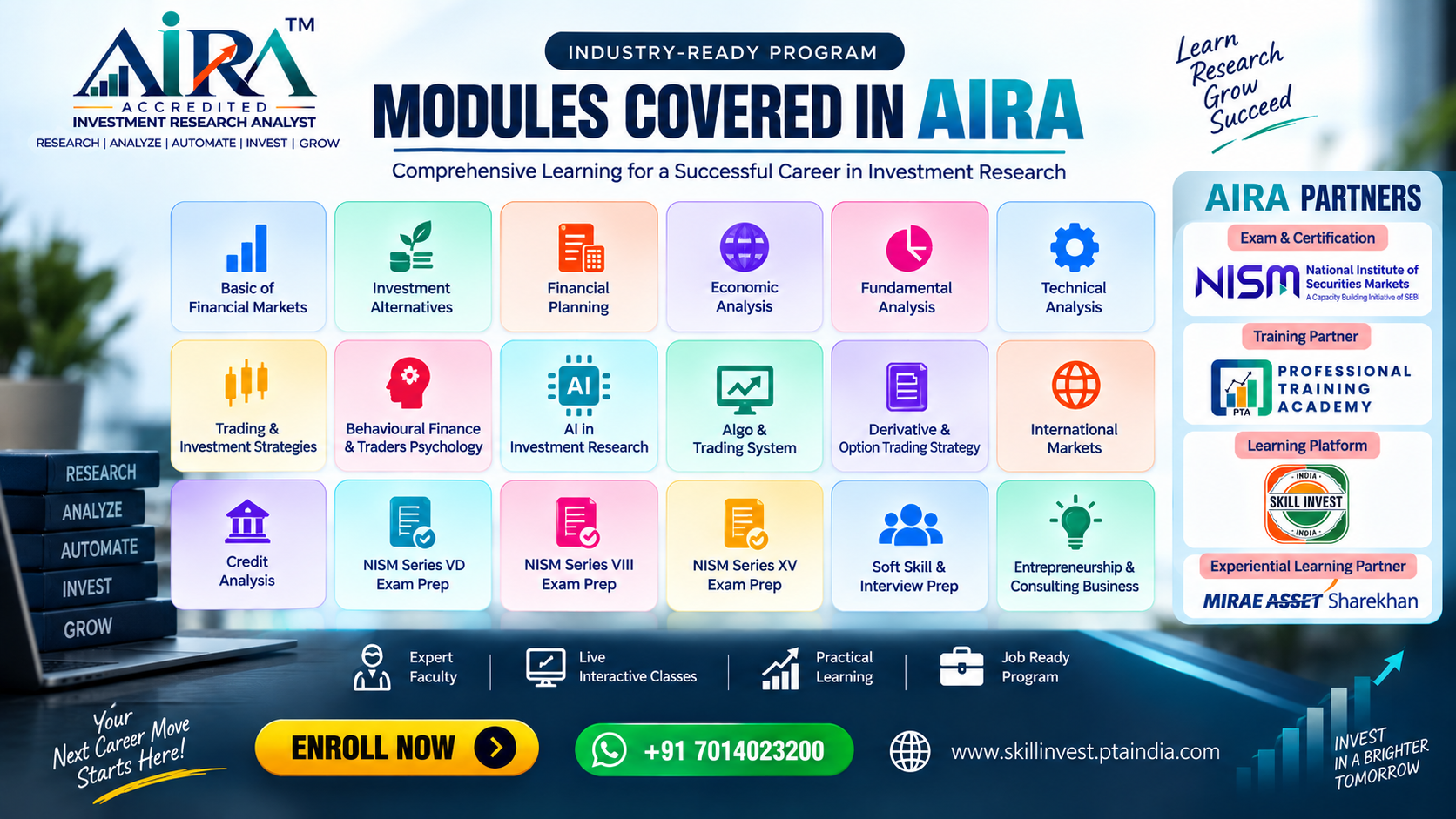
From understanding financial markets and economic conditions to fundamental analysis, technical analysis, valuation, trading strategies, portfolio concepts and AI-powered investment research, AIRA brings multiple areas of modern financial analysis into one structured learning journey.

What Is a Financial Analyst?
A financial analyst studies financial information, companies, industries and markets to help make informed financial and investment decisions.
A strong financial analyst needs more than the ability to read numbers. They need to understand why numbers change, what they mean and how they can affect a company, sector or investment decision.
Key areas include:
- Financial market analysis
- Company and business analysis
- Financial statement analysis
- Fundamental analysis
- Valuation
- Economic and sector analysis
- Investment research
- Risk and return analysis
- Portfolio and investment strategies
- Financial research reporting
Why Choose a Financial Analyst Course in India?
India’s expanding financial ecosystem has created opportunities across areas such as equity research, investment management, financial services, corporate finance, wealth management and financial consulting.
Understand Markets
Learn how financial markets, instruments and economic conditions influence investment decisions.
Analyse Companies
Study businesses through financial statements, business models, management quality.
Evaluate Investments
Use fundamental analysis and valuation concepts to assess potential investment opportunities.
Interpret Financial Data
Move beyond numbers and understand what financial ratios, statements and trends actually indicate.
Build Research Skills
Develop the ability to structure financial research and communicate your findings clearly.
Use Modern Technology
Understand how AI and technology can support financial research, screening, analysis and productivity.
Financial Analyst Course vs Stock Market Course
Stock Market Course = Learn how to understand, trade and invest in the market.
Financial Analyst Course = Learn how to analyse companies, financial information, investments and markets in a structured way.
A stock market course may introduce you to technical analysis, fundamental analysis, trading strategies, chart patterns, risk management and portfolio basics. For example, technical-analysis training typically covers support and resistance, candlestick patterns, moving averages, RSI, Bollinger Bands and money-management concepts.
A financial analyst course has a broader analytical orientation. It can include financial statement analysis, company analysis, industry and economic analysis, valuation, financial modelling, equity research, investment research and research-report preparation. These are also prominent components of current financial-analysis and equity-research programs in India.
Why Choose a Financial Analyst Course in India?
Finance
Students
Students looking to develop practical skills alongside their academic finance education.
College
Graduates
Graduates who want to explore careers in financial analysis, research and investment-related roles.
Aspiring Research Analysts
Learners interested in developing skills in company research, financial analysis and investment research.
Entrepreneurs & Finance Consultants
Professionals who want stronger financial and analytical capabilities for decision-making and consulting.
Investors
Individuals who want to understand companies and investments more systematically instead of relying only on market news or opinions.
Working Professionals
Working Professionals looking to strengthen their financial knowledge or move toward finance-related roles.
Why AIRA for Financial Analyst Skills?
AIRA – Accredited Investment Research Analyst™ takes a broader view of financial analysis by combining market knowledge with research-oriented and practical analytical skills.
The programme brings together areas including:
Financial Markets → Economic Analysis → Fundamental Analysis → Technical Analysis → Investment Strategies → Behavioural Finance → AI in Investment Research → Algorithmic Trading → Derivatives → International Markets → Communication → Consulting
This creates a learning journey designed to help learners understand not just what happens in financial markets, but how to analyse the information behind those movements.


Career Opportunities After a Financial Analyst Course
Financial
Analyst
Analyse company performance, financial statements, budgets, and business trends.
Equity Research Analyst
Research listed companies, study valuations, and prepare investment insights.
Investment Research Analyst
Evaluate investment opportunities and assess risk and return.
Research Analyst
Turn financial and market data into actionable research insights.
Credit Analyst
Assess borrowers’ financial strength and creditworthiness.
Corporate Analyst
Analyse budgets, forecasts and business financial performance.
FP&A Analyst
Drive financial planning, forecasting and performance analysis.
Portfolio Analyst
Monitor investments, portfolio performance and risk.
Risk Analyst
Identify, measure and manage financial and investment risks
Financial Analyst Course Frequently Asked Questions
The right course depends on your career objective, current knowledge, curriculum, practical exposure and the skills you want to develop. Look for a programme that covers financial markets, company analysis, financial statements, valuation, research and practical application.
Yes, a structured programme can be suitable for beginners if it starts with financial-market fundamentals before progressing to advanced analytical concepts.
A financial analyst may work with financial statements, company information, economic data, industry trends, valuation methods, market information and research reports.
One major difference is depth of analysis.
A stock market learner might analyse a company through its price chart, trend, volume, indicators and market momentum.
A financial analyst may go further by examining:
Economy → Industry → Business → Management → Financial Statements → Ratios → Growth → Risks → Valuation → Investment Thesis
This creates a more structured approach to investment research.
It does not mean technical analysis or trading is less valuable. In fact, fundamental and technical analysis can be complementary depending on the learner’s objective and methodology. NSE currently offers programs that explicitly combine both approaches.